
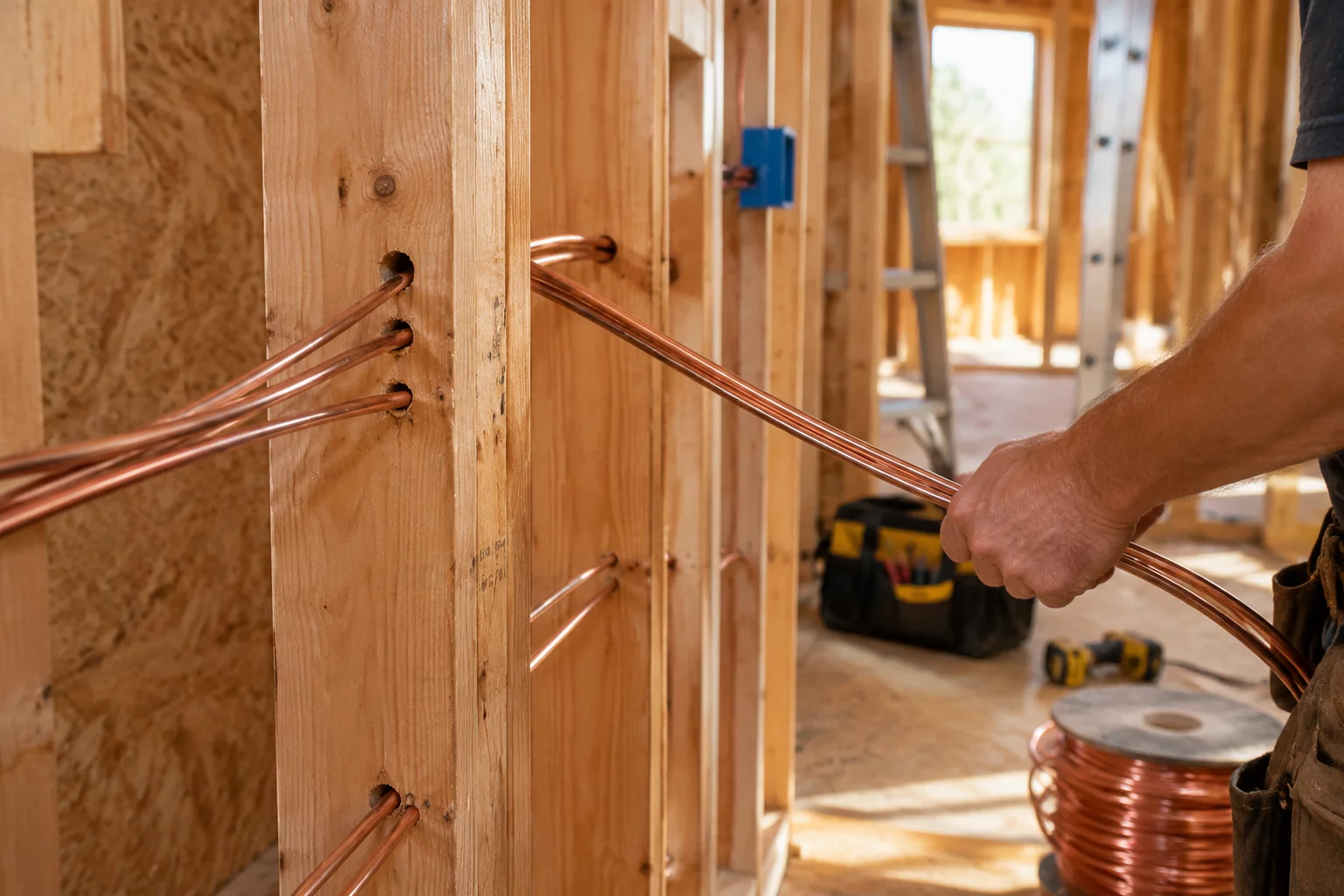
Engineered Branch Circuits for Power-Intensive Loads
Adding modern equipment often pushes existing residential infrastructure past safe thresholds. We route independent circuits directly from distribution panels to eliminate overloads, breaker trips, and fire hazards.
Dedicated Appliance Lines
Independent feeds for high-wattage induction ranges, microwaves, refrigerators, and dishwashers to prevent shared neutral overloads.
HVAC & Heat Pump Circuits
Heavy-gauge wiring configured specifically for mini-splits, central air conditioning units, and high-efficiency heat pump systems.
GFCI & AFDD Integration
Modern dual-function breakers detecting series and parallel arc faults as well as ground leakages in damp or wet environments.
Workshop & Garage Feeds
Robust branch runs designed for high-amperage air compressors, welders, table saws, and specialized home workshop machinery.
Load Calculation & Balancing
Accurate mathematical calculation of existing main busbar capacity ensuring safe phase distribution and preventing thermal buildup.
Sub-Panel Additions
Secondary distribution units installed when main panel breaker slots are exhausted, keeping wiring orderly and future expansions simple.
Engineering Assessment & Circuit Routing Protocol
Modern households routinely introduce heavy electric loads such as fast EV chargers, induction cooking surfaces, tankless water heaters, and localized climate control systems. When these units are spliced into existing general-purpose circuits, the underlying conductors overheat, creating silent fire hazards and causing protective devices to trip repeatedly.
Our licensed electricians run dedicated solid copper branch circuits through metallic or non-metallic conduits, matching wire gauge strictly to breaker trip curves and continuous load requirements. Before running new cabling, we calculate panel load limits and install tandem breakers or sub-panels where expansion room is restricted.
National Electrical Code Compliance Guarantee
All new circuits undergo rigid insulation resistance testing, loop impedance validation, and municipal safety inspections to verify that continuous current draw remains strictly below 80% of conductor capacity.
Key Facts & Technical Criteria
-
1
Copper Conductor Sizing 10 AWG to 6 AWG pure copper cabling utilized for 30A to 50A appliance requirements.
-
2
AFDD & GFCI Integration Complete arc fault and ground fault circuit interrupt technology installed at the breaker.
-
3
Voltage Drop Protection Calculated wire cross-sections to keep total line voltage drops strictly under 3%.
-
4
Permanent Conduit Routing Concealed or surface-mounted EMT conduit protects wiring across finished or utility areas.
Structured Installation & Certification Process
Our four-stage protocol ensures precise load distribution and full electrical safety code adherence.
Load Calculation
Evaluating panel busbar amperage, existing circuit distribution, and target appliance draw requirements.
Conduit & Cable Routing
Pulling heavy-duty copper wire through optimal pathways with minimum disruption to walls and ceilings.
Breaker & Outlet Hookup
Installing calibrated breakers into the distribution panel and terminating specialized high-amperage outlets.
Testing & Certification
Full load simulation, polarity checks, earth ground resistance verification, and safety sign-off documentation.
Frequently Asked Questions
Key technical answers regarding dedicated circuits, panel space limits, and safety standards.
Related Electrical Services
Explore other core engineering and modernization offerings.
Request Quote & Inspection
Complete the dispatch form for code assessment, estimates, and project scheduling.